
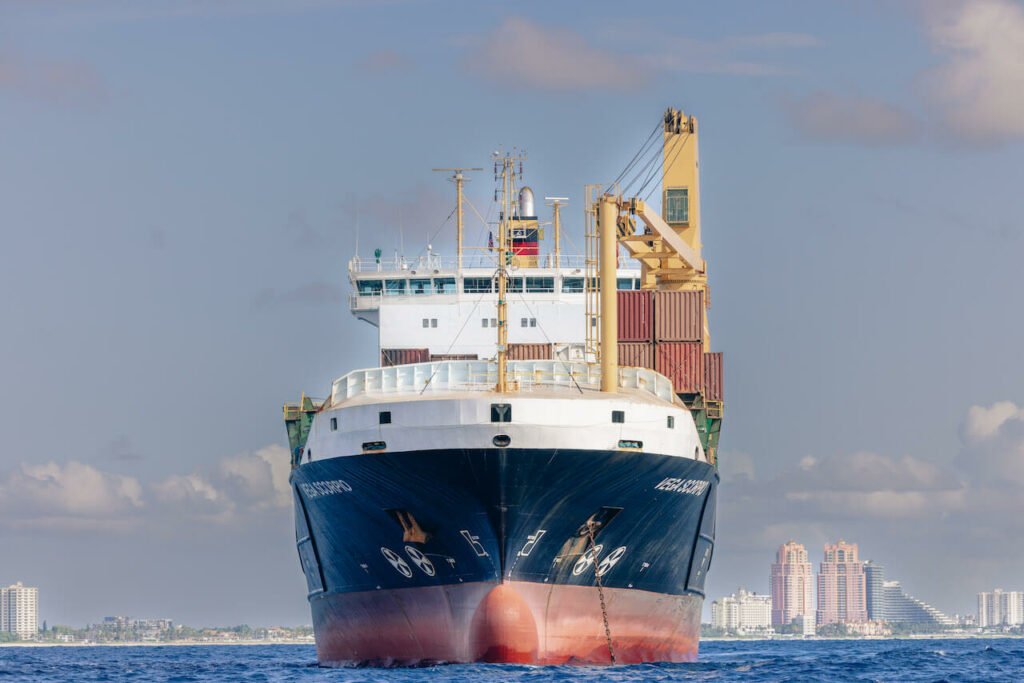
Reduce Fuel Consumption
Reduce Greenhouse Gas Emissions
Achieve Energy Efficiency Design Index
AIR LAYER DRAG REDUCTION SYSTEMS

REDUCE SHIP FUEL CONSUMPTION
AirGlide AI
Airglide AI in real time adjusts our patented air layer drag reduction system to maximize efficiencies. The air layer drag reduction system allows ships to operate with less frictional drag. Reduced drag results in lower emissions by reducing fuel consumption. Our designs are tailor-made and optimized for your specific ships using the results of world-class, cutting-edge computational fluid dynamic (CFD) software and techniques. Our design process allows AirGlide AI and the client to see the power savings and verify ALDR design before installation occurs.
NOTABLE
CO2 Reduction

REDUCE SHIP FUEL CONSUMPTION
AirGlide AI Air Layer Drag Reduction System
AirGlide AI Air Layer Drag Reduction System generates real-world, in-service, operational fuel reductions. Our hull air layer drag reduction systems are calibrated, optimized, and verified through exhaustive CFD and engineering analysis before deployment to your ship. We address the many complexities and challenges involved in the design of these systems and the physical phenomena of optimizing resistance reduction provided by an air layer drag reduction system. ALDR.com is a good resource to see the science behind air layer drag reduction technology.
Ocean shipping has a large global footprint, with 53,000 ships in the fleet annually consuming more than 300 million tons of fuel. As a result, shipping accounts for over 3% of global carbon emissions. A ship’s fuel consumption depends on many factors such as wake, frictional drag and pressure drag. Sixty to 90% of the total drag comes from friction, making it a major factor affecting fuel consumption.

REDUCE GAS EMISSIONS
Integration of Existing Green Technologies
Many Energy-Saving Devices (ESDs) aim to reduce drag and fuel consumption, including hull coatings, optimized hull design, propulsors, and propeller boss cap fins. Our air layer drag reduction systems offer substantial energy savings, while other ESDs often fall short. AirGlide AI’s air layer drag reduction (ALDR) system creates a stable layer of air below the hull using patented and proprietary air delivery devices. The air layer reduces frictional drag, resulting in lower emissions and reduced fuel consumption.
Up to 10% Fuel Savings


Reduce Greenhouse Gas Emissions
Through detailed CFD analysis, we optimize the ALDR system for each hull form, providing improved fuel oil savings and greenhouse gas reductions over legacy ALS systems
IMPROVE ENERGY EFFICIENCY
Meet or Exceed EEXI and EEDI Standards
Our ALDR technology helps you comply with IMO’s Energy Efficiency Design Index (EEDI) regulation.
In the drive toward a greener maritime industry, the role of Air Layer Drag Reduction (ALDR) Systems cannot be overstated. Mandates requiring new ships to slash CO2 emissions by at least 20-30% by 2030 have elevated the importance of innovative technologies like ALDR, recognized as an “Innovative Energy Efficiency Technology” by the IMO.
Central to this movement are key initiatives such as the Energy Efficiency Existing Ship Index (EEXI), Energy Efficiency Design Index (EEDI), and Carbon Intensity Indicator (CII) reductions. These measures form the bedrock of maritime sustainability, requiring ships to navigate with minimal environmental impact. The Energy Efficiency Design Index (EEDI) and the Ship Energy Efficiency Management Plan (SEEMP) drive global energy efficiency improvements, making them the first mandatory greenhouse gas reduction regime for an entire industry.
AirGlide AI’s ALDR system can help achieve EEDI compliance by including its savings in the 5th term of the EEDI equation.

20-30%
Reduction of Emissions by 2030

IMPROVE ENERGY EFFICIENCY
Reduce Carbon Intensity (CII)
AirGlide AI’s ALDR offers strategic advantages in reducing Carbon Intensity (CII) and achieving EEXI and EEDI compliance. The system is adaptable to diverse hull forms and provides shipowners with a preliminary Computational Fluid Dynamics (CFD) analysis, offering detailed insights into the system’s estimated impact on energy efficiency and emissions reduction.
By minimizing resistance, the AirGlide AI system decreases drag, requiring less energy for propulsion. This substantial drop in fuel consumption directly correlates with lower carbon and other exhaust gas emissions, aiding vessels in meeting EEXI and EEDI standards. By enhancing energy efficiency, AirGlide AI plays a pivotal role in propelling the maritime industry toward a sustainable and environmentally responsible future.
THE COMPLETE PICTURE
We Supply World-Class Air Layer Drag Reduction Systems (ALDR) to Ships of All Types and Sizes
Computational Fluid Dynamics
AirGlide AI can conduct CFD analysis for every ship type using cutting-edge CFD computers and software and in-house CFD experts.
Big Data
AirGlide AI uses its proprietary automation software to analyze ship data to optimize performance and confirm actual fuel savings achieved through its ALDR technology.
ALDR IP and Patents
Many of our proprietary technologies have been thoroughly tested, validated, and are now protected globally under multiple patents.
Testing Facilities
AirGlide AI has devoted capital and resources to design and build test platforms dedicated to fine-tune performance and efficiencies.
Installation
Our engineers and project managers have the ability to take an AirGlide AI ALDR from early concept design to completed installation.
Transforming Legacy ALS to ALDR
AirGlide AI has developed hardware and software leveraging true artificial intelligence to transform 20th century legacy ALS to 21st century ALDR systems.
AIR LAYER DRAG REDUCTION SYSTEMS
Popular questions
-
Our air layer drag reduction systems are designed for longevity and minimal maintenance over the service life of a vessel.
The air compressors and distribution piping that make up an ALDR use rugged, marine-grade components rated for continuous operation in harsh ocean environments.
All parts are easily accessible for routine inspection and maintenance. With basic upkeep, the hardware can function reliably for the full lifespan of a ship. The air nozzles will experience minimal corrosion and fouling due to the materials and constant airflow. Once integrated into a ship, it can provide fuel efficiency benefits over the life of the ship.
-
Air layer drag reduction is a proven technology that can reduce friction between a ship's hull and the water. When optimized, air layer drag reduction can deliver noteworthy efficiency improvements and cost savings.
This approach reduces friction by minimizing the portion of the hull in direct contact with water. With correctly placed low drag air release systems, the technology can distribute air evenly for a stable air layer.
Research continues to fully harness the potential of air layer drag reduction. Engineers are refining air injection methods and placement to maximize performance. Adoption has been gradual but is expected to increase overtime, as the data from current installations accumulates.
Air layer drag reduction provides a proven method to meaningfully improve ship propulsion efficiency. With ongoing development, these systems are seeing widespread implementation and are making a significant impact on global maritime transport. The technology has demonstrated the ability to reduce fuel consumption, emissions, and emissions penalties for the shipping industry.
-
Yes, our air layer drag reduction systems can be turned off if needed since the technology is fully integrated into the ship's automation. However, there are limited operational scenarios, such as insufficient ship speed, where turning off an ALDR would provide benefits.
Unlike protruding air release systems from some competitors that create drag when not in use, our air nozzles are flush with the hull. When the ALDR is powered down, the nozzles pose no to minimal additional drag. Therefore, inherent drag is not a factor when the system is off.
Turning off the ALDR would however eliminate its resistance reduction benefits. Our system is designed for continuous operation and delivers maximum benefits through continuous optimized operation in virtually all conditions.
-
Several factors make air layer drag reduction systems more effective, such as larger ships with higher speed itineraries and percentages of flat bottom hull. Larger flat bottom hull surface area provides more space for a consistent, stable air layer to form and be maintained. Large ships have greater weight and engine power, so reducing their higher friction yields more significant fuel savings. Higher ship speeds increase overall friction and resistance. Reducing this elevated friction via air layer drag reduction yields comparatively higher fuel savings at faster speeds to a certain point.
Combining these factors allows our air layer drag reduction systems to deliver their greatest fuel-saving performance, compared to smaller ships, going slower speeds.
-
The previous technology, air lubrication systems (ALS), has been trialed on well over 150 ships across the cruise, dry bulk, container, and tankers segments, and has been shown to reduce fuel consumption and carbon emissions. These systems can be greatly enhanced with the implementation of AirGlide AI’s patented air layer drag reduction systems (ALDR).
Air layer drag reduction (ALDR) systems have significantly improved performance by enhancing an ALS system on the largest cruise ship in the world, verified per DNV RP 0695.
-
AirGlide AI's software platform extends far beyond traditional sea-trial analysis by continuously monitoring vessel performance while the vessel is operating in real-world conditions. The system evaluates operational data across varying drafts, loading conditions, weather patterns, sea states, routes, speeds, and operational profiles. This allows vessel operators to understand not only whether the technology is capable of producing savings under controlled conditions, but also the actual savings being realized throughout daily operations.
This distinction is important because regulatory compliance, emissions reduction, fuel consumption, and economic performance are ultimately determined by how a vessel performs over thousands of operating hours rather than during a limited trial period. Continuous operational measurement provides a substantially larger data set and enables a more accurate assessment of long-term performance, emissions reductions, and return on investment.
The AirGlide AI platform is designed to support ongoing verification, reporting, optimization, and compliance activities by providing continuous visibility into vessel efficiency performance. As environmental regulations continue to evolve, this capability positions AirGlide AI to document and demonstrate measurable operational improvements using real-world operational data collected throughout the life of the vessel.
By combining patented Air Layer Drag Reduction technology with advanced artificial intelligence, machine learning, predictive analytics, and continuous operational monitoring, AirGlide AI delivers not only a fuel-saving technology, but also a comprehensive vessel-performance intelligence platform capable of supporting fleet-wide efficiency, sustainability, and decarbonization initiatives.
Calculating fuel savings is based on sea trials with the system on and off and by recording performance data for up to three months before and after installation.
CFD analysis and (if possible) underway measurement is first done on the bare hull to determine baseline performance. Air layer drag reduction nozzles are then added to the digital model at different locations and simulations run at various speeds. This CFD analysis optimizes actual nozzle placement for maximum efficiency.
Controlled sea trials are conducted on the upgraded ship to compare efficiency with and without the air layer drag reduction system active. The onboard propulsion power sensors provide real-time load data, while factors like speed, maneuvering, hull fouling condition, wind, currents and sea state are monitored and accounted for.
By combining the computational simulations and physical trials, the fuel savings from air layer drag reduction can be accurately calculated.